
Water is arguably the most vital resource flowing through any property, yet it is often the most overlooked until a crisis occurs. From the invisible network of pipes beneath the lawn to the complex chemical balance of the liquid in your glass, water influences your health, the longevity of your expensive appliances, and the ultimate market value of your real estate. Managing this resource effectively is no longer just about fixing a leaky faucet; it is about adopting a holistic strategy that encompasses infrastructure integrity, sophisticated purification technologies, and sustainable consumption patterns.
Modern property owners face a growing array of challenges, from aging municipal infrastructure and emerging chemical contaminants like PFAS to the increasing hardness of local groundwater. Addressing these issues requires more than a one-size-fits-all filter from a big-box store. It requires an in-depth understanding of how water enters your home, how it is conditioned for use, and how to maintain the systems that keep it safe and efficient. Whether you are connected to a city main or rely on a private well, the transition from passive usage to active oversight is a journey toward sustainability and peace of mind.
This guide provides a comprehensive roadmap for optimizing your property’s water resources. We will explore the critical steps for auditing your intake infrastructure, protecting self-sustained sources, and implementing high-level treatment plans tailored to your specific local chemistry. By the end of this discussion, you will be equipped with the actionable knowledge needed to transform your home into a model of efficiency and quality.

Mapping the Gateway: Inspecting Main Lines and Utility Entry Points
Every comprehensive management strategy must begin at the perimeter. The point where water transitions from a public utility or a private source into your personal plumbing system is the most critical juncture for efficiency. If there are structural failures or flow restrictions at this entry point, every other system inside the home will underperform. Many homeowners are surprised to learn that they are responsible for the service line that runs from the street to the house, making regular inspections of this “invisible” infrastructure a financial necessity.
A thorough audit of your intake begins with a physical inspection of the exterior meter pit and the main interior shut-off valve.
-
Locate Your Shut-Off Points: Every resident should know exactly where the main valve is located. In an emergency, such as a burst pipe, the ability to kill the flow instantly can save tens of thousands of dollars in restoration costs.
-
Conduct a Static Pressure Test: Using a simple, inexpensive pressure gauge attached to an outdoor hose bib, you can determine if your intake pressure is within the safe range of 40 to 60 PSI. Pressure exceeding 80 PSI can cause “water hammer,” which vibrates and eventually ruptures copper joints and destroys appliance valves.
-
Perform a “Silent Leak” Check: Turn off all water-using appliances and check your meter. If the low-flow indicator is spinning, you have a leak somewhere between the meter and your faucets. Often, these leaks occur underground in the service line itself.
When planning landscape upgrades, adding an ADU, or expanding your home’s footprint, you must ensure that your current water service connections are sufficient to handle the increased demand. An undersized line will lead to frustrating drops in pressure when multiple fixtures are used simultaneously. This level of oversight is a fundamental pillar of comprehensive water management, ensuring that the volume and pressure entering the property are optimized for both safety and convenience before a single drop reaches your kitchen or bath.
Protecting the Source: Maintenance Protocols for Private Well Systems
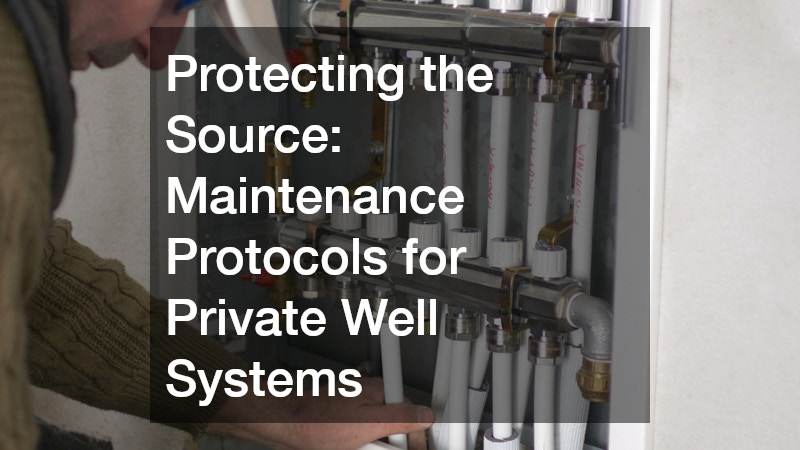
For millions of property owners, water does not come from a city treatment plant but from a private well tapping into a local aquifer. While this offers independence from utility bills, it places the entire burden of safety and maintenance on the owner. A private well is a direct straw into the earth, and without a strict protocol for protection and maintenance, it can easily become a gateway for bacteria, nitrates, or heavy metals to enter your home.
The health of a well depends on both mechanical integrity and geological awareness.
-
Inspect the Well Head and Cap: Ensure the well casing extends at least 12 inches above the ground and that the cap is vermin-proof and tightly sealed. A cracked cap can allow insects, rodents, or surface runoff—laden with fertilizers and pesticides—to fall directly into your drinking supply.
-
Maintain a Buffer Zone: Keep a 100-foot radius around the well head free from “high-risk” activities. This means no hazardous chemical storage, no septic system components, and no heavy livestock presence, as these can leach pollutants through the soil and into the groundwater.
-
Annual Flow and Quality Testing: You should have your water tested annually for coliform bacteria and nitrates. Additionally, every three to five years, perform a comprehensive scan for local geological concerns, such as arsenic, lead, or radon, which are common in many residential aquifers.
Property owners who rely on these self-sustained systems should establish a long-term relationship with a certified water well company. These professionals have the specialized equipment, such as down-hole cameras and high-capacity pumps, to perform deep-well inspections and drawdown analysis. Utilizing these professional water management services ensures that your pump is operating at peak efficiency and that your well is not at risk of running dry or suffering from structural failure, which could cost thousands to remediate if left unchecked.
Neutralizing Hard Water: Preserving Appliances and Piping via Ion Exchange
One of the most pervasive threats to the physical structure of your plumbing and the efficiency of your appliances is “hard water.” This term refers to high concentrations of dissolved minerals—primarily calcium and magnesium—found in the groundwater of nearly 85% of the country. While not a health hazard, hard water creates a “scale” buildup that acts like cholesterol in your pipes, slowly narrowing the diameter and forcing your water heater to work much harder to penetrate the mineral crust.
The symptoms of hard water are easy to spot but often ignored: white, chalky spots on glassware, stiff laundry, and a film on shower doors. Over time, this scale will destroy the heating elements in your dishwasher and significantly shorten the lifespan of your tankless water heater.
-
Calculate Your Grain Capacity: Systems are sized based on “grains of hardness.” To choose the right size, multiply the number of people in your home by the gallons used per day, then multiply that by the hardness level (found via a water test).
-
Automate Your Regeneration: Modern systems use “demand-initiated regeneration,” which only flushes the system when necessary, saving significant amounts of water and salt compared to older timer-based units.
-
Protect the Entire Loop: Conditioning the water at the point of entry ensures that your expensive faucets and showerheads remain free of clogs and unsightly mineral deposits.
For most households, installing a high-efficiency water softener is the gold standard for removing these minerals through a process called ion exchange. This physically removes the calcium and magnesium, replacing them with a tiny amount of sodium. However, for those on sodium-restricted diets or those who prefer not to use salt, a water conditioner may be an appropriate alternative. While a conditioner does not technically “soften” the water by removing the minerals, it alters their crystalline structure so they cannot stick to surfaces, effectively preventing scale without changing the chemical makeup of the water.
The Multi-Stage Defense: Removing Chemical Contaminants and Micro-Plastics
While softening protects your plumbing, filtration protects your body. Even municipal water that meets federal standards often contains additives like chlorine and chloramines, which are necessary for disinfection but can affect the taste and smell of your water and dry out your skin. Furthermore, “emerging contaminants” such as micro-plastics and pharmaceutical runoff are increasingly being detected in tap water across the country.
A robust defense strategy typically involves a multi-stage approach, combining Point-of-Entry (POE) filtration for the whole house with Point-of-Use (POU) purification for drinking and cooking.
-
The Carbon Block Barrier: Activated carbon is exceptionally effective at absorbing volatile organic compounds (VOCs), pesticides, and the “pool-like” smell of chlorine. This should be the first line of defense in any filtration setup.
-
Reverse Osmosis (RO): For the highest purity, an RO system uses a semi-permeable membrane to strip away up to 99% of dissolved solids, including lead, arsenic, and nitrates.
-
Micron Ratings Matter: Look for filters with a sub-micron rating to ensure that even the smallest sediment and cysts are captured before they reach your glass.
A high-performance water filtration system provides the peace of mind that your family is shielded from the vast array of pollutants found in modern water supplies. Many advanced RO systems now include a final “polishing” stage that adds beneficial minerals back into the water to balance the pH. This allows health-conscious homeowners to enjoy the clean, crisp taste of alkaline water directly from a dedicated kitchen tap, combining the safety of medical-grade purification with the hydration benefits of mineral-rich drinking water.

Tailored Remediation: Addressing Specific Biological and Chemical Imbalances
Every property is located in a unique geological and industrial landscape, meaning that a “standard” filter might be completely ineffective against your specific water profile. Some regions suffer from high iron levels that leave orange stains on everything it touches, while others deal with hydrogen sulfide, which creates a pervasive “rotten egg” odor. Solving these specific problems requires moving beyond simple filtration into the realm of targeted chemical and biological remediation.
Determining the right treatment path requires a professional analysis that looks beyond basic hardness.
-
Ultraviolet (UV) Sterilization: If your water test shows the presence of E. coli or other bacteria, a UV light system is a non-chemical way to scramble the DNA of microorganisms, making them unable to reproduce and effectively sterilizing your supply.
-
Air Injection and Oxidation: For water that smells like sulfur or contains high levels of manganese, air injection systems can oxidize the minerals, turning them into a solid form that can then be easily filtered out.
-
pH Balancing: If your water is acidic (low pH), it will slowly dissolve your copper pipes, leading to “blue-green” staining and eventual pinhole leaks throughout your home. An acid neutralizer tank is necessary to bring the water back to a neutral state.
Because these issues are often complex and intertwined, consulting with a reputable water treatment company is the most reliable way to design a system that works. They can perform a detailed site analysis and prescribe specific water treatments—such as specialized resin beds or chemical feed pumps—that are precisely calibrated to your home’s chemistry. This tailored approach ensures that you aren’t spending money on unnecessary equipment while neglecting the specific contaminants that pose the greatest risk to your property and health.
Sustaining the System: Creating a Calendar for Maintenance Cycles
The most advanced water system in the world is only as good as its last maintenance check. One of the most common mistakes property owners make is the “set it and forget it” mentality. Over time, filter media becomes saturated, UV bulbs lose their intensity, and softener resins can become fouled with iron. An unmaintained system can actually become a breeding ground for bacteria, making your water quality worse than if you had no system at all.
Effective management requires a proactive maintenance calendar that treats your water system with the same importance as your HVAC or roofing.
-
Filter Change Schedule: Most sediment and carbon filters need to be changed every six to twelve months. Mark these dates on your calendar or use smart-home leak detectors that track water volume and alert you when a change is due.
-
Sanitize the Brine Tank: Once a year, it is a good practice to empty and clean your water softener’s brine tank to prevent “salt bridges” and the buildup of “mush” that can clog the system’s intake.
-
Test Your Output: Don’t just test the water coming into your house; test the water coming out of your taps once a year. This verifies that your filtration and conditioning systems are actually performing as intended and haven’t been bypassed by a mechanical failure.
Integrating smart technology into your water loop is a modern necessity. Wi-Fi-enabled flow monitors can detect a tiny drip behind a wall or a toilet that is “running,” alerting you via a smartphone app before the issue leads to a massive utility bill or property damage. By combining these digital tools with a consistent professional maintenance routine, you ensure that your investment in water quality remains effective for decades.
The Value of Proactive Stewardship
Transitioning from a passive user of water to a proactive manager of the resource is one of the most impactful changes a property owner can make. It is a decision that pays immediate dividends in the form of better-tasting water, softer skin, and brighter laundry. Long-term, the benefits are even more profound, as you prevent the slow, expensive destruction of your plumbing infrastructure and the premature failure of high-end appliances.
Beyond the personal benefits, a property that features a modern, well-documented, and professionally maintained water system holds a significant advantage in the real estate market. Future buyers are increasingly savvy about environmental concerns and infrastructure costs; providing them with a “turn-key” water solution that guarantees safety and efficiency is a powerful selling point that sets your property apart.
Ultimately, the goal of better management is to provide your household with the highest quality of life while minimizing your environmental footprint and financial risk. By auditing your intake, choosing the right conditioning and filtration technologies, and staying committed to a rigorous maintenance schedule, you can ensure that the water flowing through your home remains a source of health and comfort rather than a source of stress. Start with a professional water test this week to establish your baseline—it is the first step toward a smarter, safer, and more sustainable home.
